Updated September 2026
Google AdMob can produce almost no income at all, a useful side income, several thousand dollars a month, or enough to support a developer full-time. After reviewing nearly 100 developer discussions and earnings reports, the clearest conclusion was also the least useful answer for anyone hoping for a simple calculator: there is no normal AdMob income.
Two apps with similar download counts can earn completely different amounts. An app with fewer daily users can outperform one with twice as many. A banner impression in one country can be worth a fraction of a rewarded-video impression in another. An app can attract a lot of traffic and still monetize poorly, while another with a smaller but more engaged audience can build a meaningful business.
We found developers celebrating their first few cents, others taking years to reach €10 a month, small portfolios earning around $50 a month, individual games reaching a few hundred dollars, apps producing several thousand dollars, and developers who say advertising now supports them full-time.
The useful question, therefore, is not simply how much AdMob pays. It is why one app earns almost nothing while another makes real money, and what the developers who reach meaningful income actually did differently.
What We Found
Several conclusions appeared repeatedly across individual developer reports, Google's own documentation and larger mobile-advertising datasets.
There is no reliable fixed AdMob rate. Google reports performance through metrics such as impressions, match rate and eCPM, but eCPM changes with the audience, platform, ad format, advertiser demand and time period. A universal figure such as "$5 per 1,000 views" can be useful for an example, but not as a prediction.
User count alone is a poor earnings predictor. One of the strongest examples in our research came from a developer managing two apps. Their local radio app had roughly 1,000 daily active users and earned around $30 per day. Their utility app had roughly 2,000 daily active users but earned only around $10 per day. The radio sessions lasted more than 30 minutes, while the utility sessions barely exceeded two.
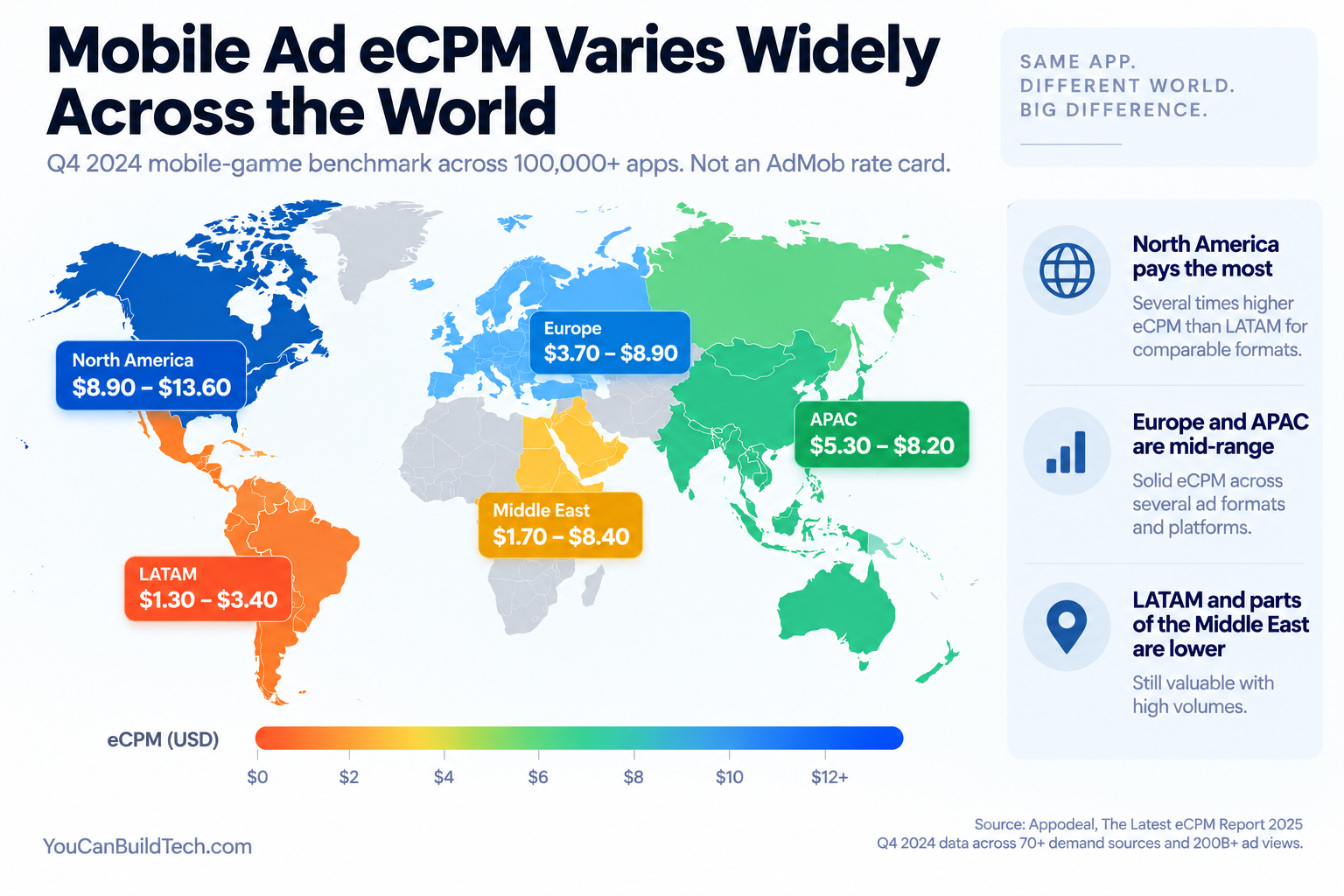
Country and ad format can move revenue by several multiples. Large industry datasets consistently show substantial differences between North America, Europe, Latin America, Asia and other regions, while rewarded ads and interstitials generally produce much higher eCPMs than banners.
Publishing more apps gives a developer more attempts, not guaranteed income. Several developers in our dataset had portfolios where one app generated most of the revenue. Others had released many apps and still earned very little.
Full-time income is possible, but we cannot tell you how common it is. One developer with a finance education app reported around 13,000 daily active users and said roughly 99% of their income came from advertising. Another reported supporting themselves from apps for years at substantially larger scale.
That distinction between what is possible and what is typical matters throughout this article. We found plenty of evidence showing what real developers have experienced. We did not find a representative public dataset showing what percentage of all AdMob developers earn $100, $1,000 or $5,000 per month.
Sources for this section: Google AdMob eCPM documentation; Google AdMob reporting metrics; Appodeal 2025 eCPM Report; Reddit developer reports covering the radio/utility comparison and full-time-income cases.
How Much Does AdMob Pay Per 1,000 Views?
Most discussions about AdMob eventually arrive at eCPM, or effective cost per thousand impressions.
The calculation is straightforward:
eCPM = earnings ÷ impressions × 1,000
If an app produced a $6 eCPM, for example, 1,000 impressions would generate about $6, 10,000 impressions about $60, and 100,000 impressions about $600.
| Ad impressions | Revenue at an illustrative $6 eCPM |
|---|---|
| 1,000 | $6 |
| 10,000 | $60 |
| 100,000 | $600 |
| 1,000,000 | $6,000 |
But $6 is only an example. A developer can see an eCPM below $1 in one situation and well above $10 in another. A rewarded ad shown to a US user can be worth dramatically more than a banner shown elsewhere, and even the same app can see meaningful changes over time as its audience, seasonality and advertiser demand change.
Google also warns against interpreting eCPM in isolation. A higher eCPM does not necessarily produce more total revenue if fewer impressions are being shown. The better question is not "What eCPM should I expect?" but "What eCPM am I getting, from which users and formats, and how many impressions are actually being served?"
This is why simple online calculators can become misleading. They often take a user count, apply one assumed CPM, and produce a revenue estimate that looks more precise than the underlying economics deserve.
Sources: Google AdMob documentation explaining eCPM and reporting metrics.
Requests, Impressions and the Traffic That Actually Makes Money
An app can ask AdMob for an ad without an ad ever appearing.
Google separates this process into several measurements. Requests record how often the app asks for an ad. Matched requests show how often an ad source responds. Impressions measure ads actually displayed, while match rate shows the percentage of requests that received an ad.
The distinction matters because large traffic numbers can look impressive while hiding weak monetization. Some developers in our research reported thousands of requests but relatively few impressions. Others saw revenue fall sharply even while downloads or user activity continued.
Google can also limit ad serving while assessing traffic quality or detecting invalid activity. This means an otherwise successful app can lose much of its advertising value even though the audience itself has not disappeared.
A more realistic way to think about AdMob revenue is:
Active users × how they use the app × sensible ad opportunities × ads actually served × value of those ads
It is still simplified, but it explains far more than download count alone.
Sources: Google AdMob reporting metrics, ad-serving-limit documentation and invalid-traffic documentation.
Why 1,000 Users Can Earn More Than 2,000
The radio-app example is worth looking at more closely because it captures several parts of the AdMob equation at once.
The developer reported roughly 1,000 daily active users for a local radio app and about 2,000 for a utility app. Yet the radio app reportedly earned around $30 per day while the utility earned around $10. The difference was not simply user count. Radio sessions lasted more than 30 minutes, while utility sessions barely exceeded two.
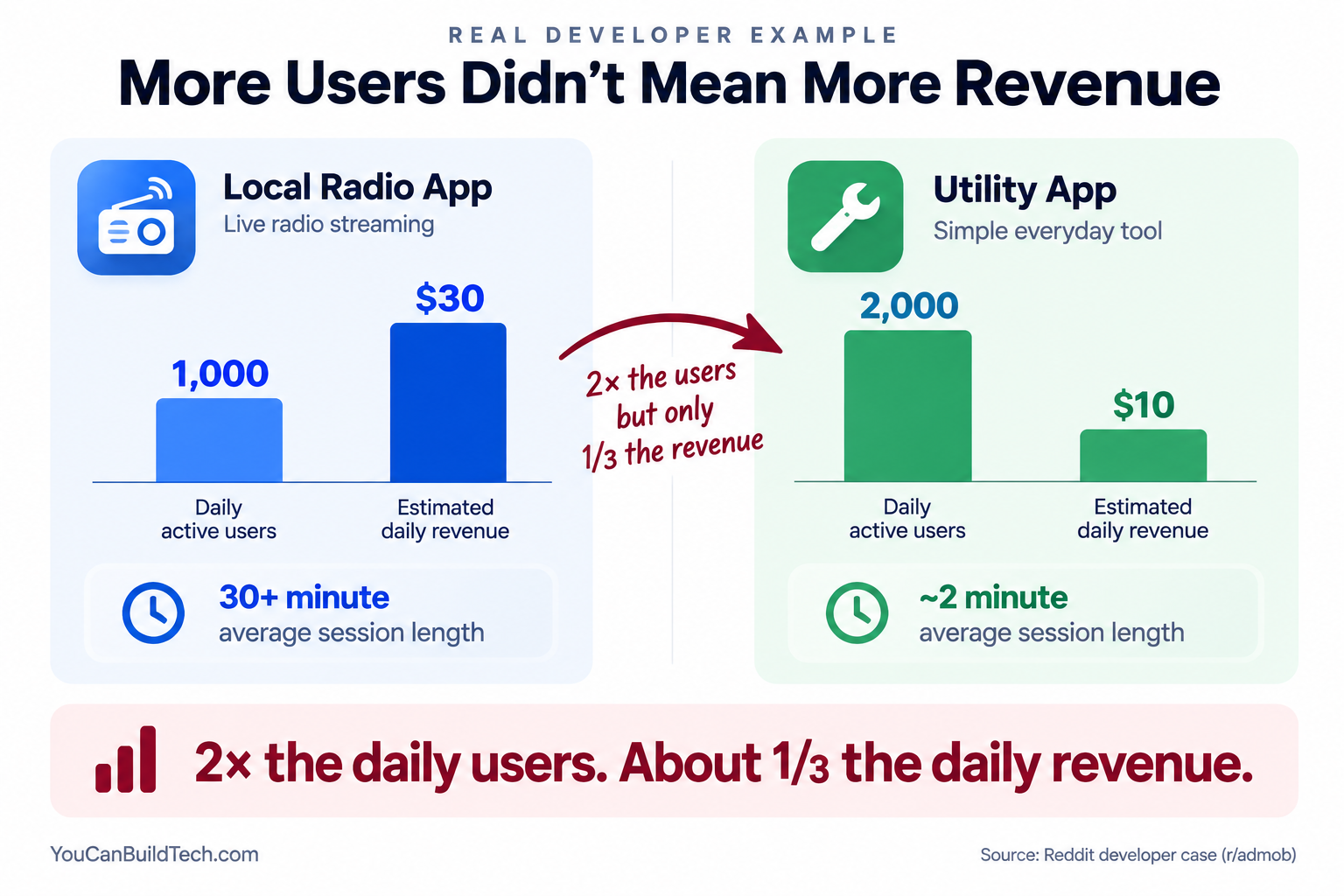
Longer sessions do not automatically guarantee more revenue, and the apps may also differ in geography and ad formats. But the example demonstrates why daily active users are not enough to predict earnings.
A person who opens an app for 90 seconds and leaves might create one practical advertising opportunity. A radio listener staying for half an hour creates many more. A game player might voluntarily watch a rewarded video to continue, while a utility user who returns every day for a year can become more valuable than several users who install once and never come back.
Google reports metrics such as impressions per active user and impressions per session for exactly this reason. The number of users matters, but the behavior behind that number often matters more.
Source: Reddit developer case, “Is this good or am I not getting enough?”
The Type of Ad Matters
The three formats most beginners encounter are banners, interstitials and rewarded ads. Banner ads remain visible in part of the interface. Interstitials normally occupy most or all of the screen and are intended for natural breaks. Rewarded ads are voluntarily watched in exchange for something useful inside the app or game.
The revenue differences can be substantial.
One developer in our research reported an average day with 3,147 rewarded impressions generating $16.77, while 18,861 banner impressions generated only $3.31. In other words, the rewarded ads produced more than five times the revenue from roughly one-sixth as many impressions.
That is a single developer report and should not be treated as a universal rate. However, Appodeal's much larger 2025 dataset points in the same general direction, with rewarded video producing the highest eCPMs overall and banners consistently near the bottom.
This is where product design and monetization become inseparable. A game can offer a rewarded continue, an extra life or a bonus. An app with clear screen transitions may have natural places for an interstitial. A utility someone opens for 20 seconds may have very few opportunities to show a high-value ad without becoming irritating.
The theoretical highest-paying format is useless if it damages the experience badly enough that users stop returning.
Sources: Reddit developer case with rewarded/banner figures; Appodeal 2025 eCPM Report; Google AdMob ad-format documentation.
Where Your Users Live Can Change the Economics
The relevant country is not where the developer lives. It is where the users live.
AdMob reporting allows performance to be broken down geographically because advertisers value audiences differently across markets. A developer in India can have a mostly American audience, while a developer in the United States can have users concentrated in Brazil or Indonesia. Their advertising economics can therefore be completely different.
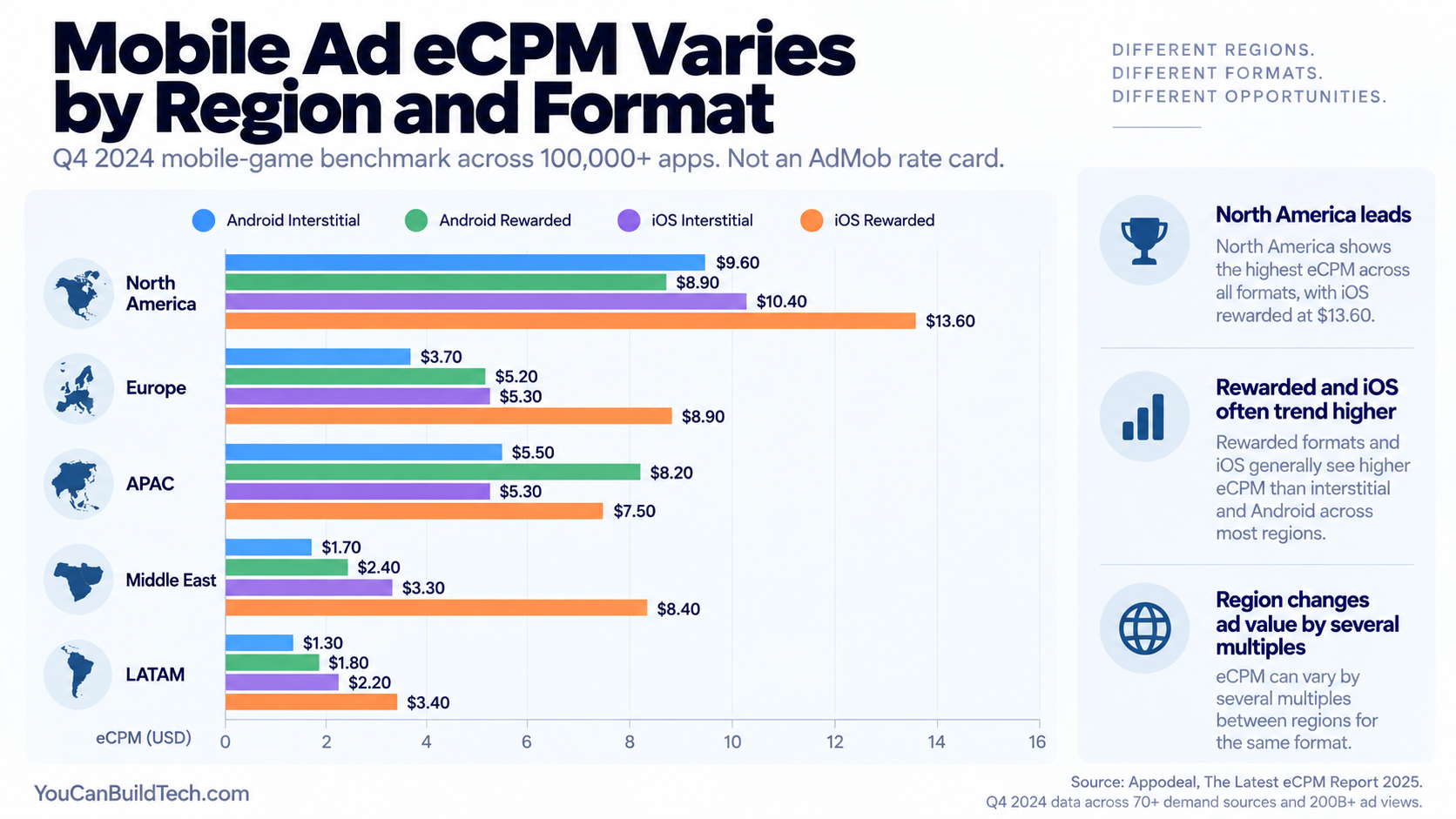
Appodeal's Q4 2024 benchmark shows the scale of these differences.
Android data
| Region | Banner | Interstitial | Rewarded |
|---|---|---|---|
| APAC | $0.10 | $5.50 | $8.20 |
| Europe | $0.20 | $3.70 | $5.20 |
| LATAM | $0.10 | $1.30 | $1.80 |
| Middle East | $0.10 | $1.70 | $2.40 |
| North America | $0.50 | $9.60 | $8.90 |
iOS data
| Region | Banner | Interstitial | Rewarded |
|---|---|---|---|
| APAC | $0.10 | $5.30 | $7.50 |
| Europe | $0.20 | $5.30 | $8.90 |
| LATAM | $0.10 | $2.20 | $3.40 |
| Middle East | $0.10 | $3.30 | $8.40 |
| North America | $0.40 | $10.40 | $13.60 |
Caption: Large-scale mobile-game advertising data shows why one global eCPM figure is misleading. Geography, operating system and ad format can all change the value of the same 1,000 impressions by several multiples.
Source: Appodeal, The Latest eCPM Report 2025. Q4 2024 data across 70+ demand sources and 200B+ ad views.
For readers who want the most useful figures without the very low banner values, the same dataset can be summarized more compactly:
Regional Interstitial and Rewarded eCPM
| Region | Android Interstitial | Android Rewarded | iOS Interstitial | iOS Rewarded |
|---|---|---|---|---|
| APAC | $5.50 | $8.20 | $5.30 | $7.50 |
| Europe | $3.70 | $5.20 | $5.30 | $8.90 |
| LATAM | $1.30 | $1.80 | $2.20 | $3.40 |
| Middle East | $1.70 | $2.40 | $3.30 | $8.40 |
| North America | $9.60 | $8.90 | $10.40 | $13.60 |
These are broader mobile-advertising benchmarks, not guaranteed AdMob payouts. They also come from Q4, when advertiser demand can be seasonally strong. But the gaps are large enough to make one point clear: a global average can hide the most important part of an app's economics.
Even the question "Which country pays the most?" is incomplete. The answer changes with platform, format, audience and time.
Can You Just Target High-Paying Countries?
Developers can influence where users come from. They can localize their store listing, advertise in specific markets, create content for a particular country or language, and choose which regions to support.
What they cannot do is turn a low-value audience into a high-value one simply by changing a setting inside AdMob.
There is another complication. The countries with valuable advertising audiences can also be expensive places to acquire users.
One developer in our research spent $112 on Google Ads and reported around $5 in AdMob revenue during the period they were evaluating. A commenter in the same discussion reported spending $170 and receiving roughly $80 in AdMob revenue plus another $20 in in-app purchases.
This does not prove paid acquisition cannot work. Acquired users may return for months and produce more lifetime revenue than they generate immediately, while paid campaigns can sometimes help an app gain organic momentum.
What it does show is that buy users, show ads, make guaranteed profit is not a dependable model.
Sources: Reddit paid-acquisition case; Google Ads location-targeting documentation.
What Do Real Developers Actually Earn?
The cases we collected cover an enormous range.
At the smallest end, one solo developer with around 50 downloads reported their first €0.22 after a little over a month. They were delighted to have generated anything at all.
Another developer said they had used AdMob for roughly four years before finally passing €10 in a month. They had around four Android apps and three iOS apps, but roughly 90% of the revenue came from one iOS app.
A different developer reported $49.09 in one month across six small apps, up from $41.74 in the previous comparison period. Their stated goal was not an overnight hit, but to continue releasing small apps, learn which ideas attracted users and work toward $100 per month. AI had made that experimentation considerably easier.
A game developer reported $135 in the first month and $325 in the second, with most users coming from the United States and advertising spread across banners, interstitials and mediation.
Another solo game developer reached roughly $200 per month after previously earning around $67. They attributed the improvement to better App Store Optimization, keywords in the title, translations and more attractive screenshots. They also said the traffic was entirely organic and that many earlier games had failed.
Further up the scale, the finance-app developer mentioned earlier reported approximately 13,000 daily active users and said the app had supported them for more than a year, with around 99% of the income coming from ads. Other developers in the same discussion reported living from apps at substantially larger scale.
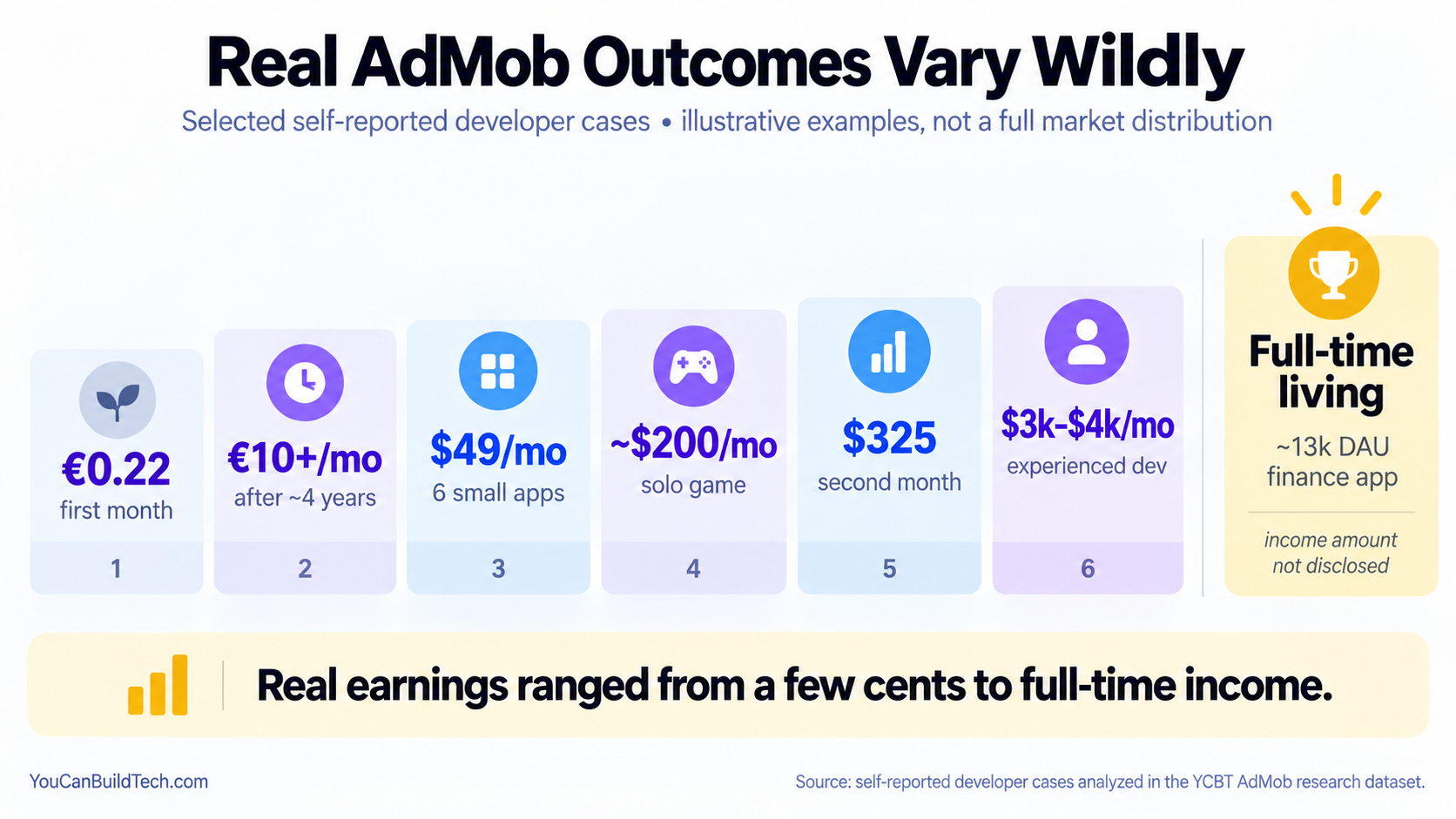
Selected Developer Cases
| Developer situation | Reported scale | Reported income | Important context |
|---|---|---|---|
| New solo app | ~50 downloads | €0.22 | First month |
| Multi-app developer | ~200 DAU main app | €10+/month | ~90% from one app |
| Small portfolio | 6 apps | $49.09/month | Treating apps as experiments |
| Solo game | Small active audience reported | ~$200/month | Organic + ASO |
| New game | — | $325 in month two | Mainly US audience |
| Finance app | ~13k DAU | Full-time living | Reportedly ~99% ads |
Research note: These are selected self-reported cases, not a representative sample of AdMob developers.
These are first-person reports, not audited financial accounts. Reddit also overrepresents people who have a reason to post, whether because they hit a milestone, something went unusually badly, or their revenue suddenly changed.
Even with those limitations, the cases answer one important question convincingly: meaningful and even full-time advertising income exists. What they do not tell us is how common it is.
Sources: Individual developer reports covering the €0.22 first month, €10+ month, $49.09 portfolio month, $325 second month, roughly $200 organic month and full-time finance-app income.
How Long Does It Take?
There is no credible average in the public evidence we found.
Some developers generate their first advertising revenue within days or weeks. Others spend years producing very little. Some slowly build an audience, some improve their store listing and begin growing, some hit a social-media or algorithmic breakout, and others publish multiple apps until one becomes significantly more successful than the rest.
The research therefore reveals two different timelines that should not be confused.
The first is how quickly an individual user begins generating advertising revenue. This can happen almost immediately. AppsFlyer's 2026 monetization study found that in-app advertising generates 57% of its Day-60 revenue on Day 1 and 89% by Day 7.
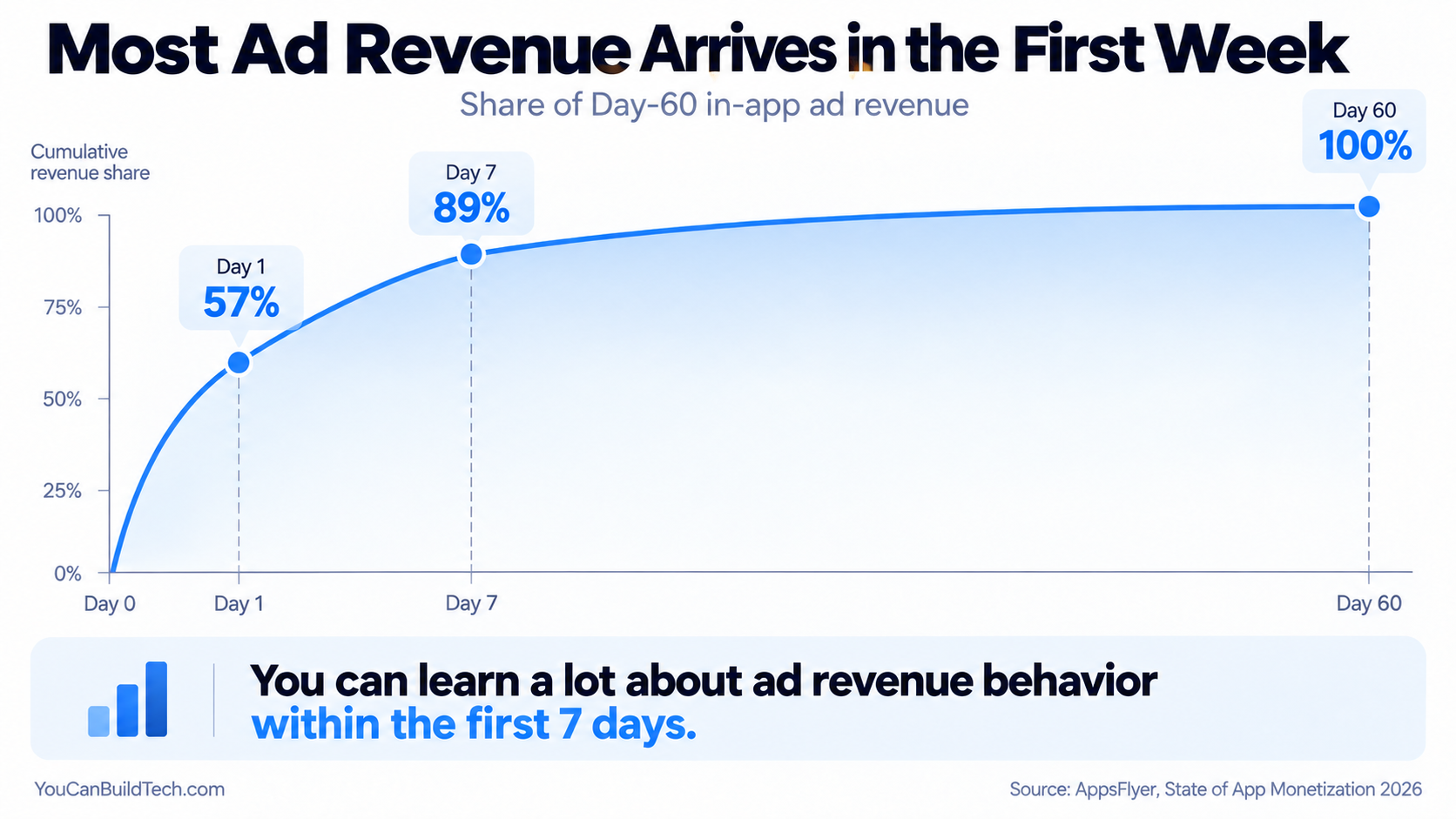
This does not mean an app succeeds within seven days. It means the revenue behavior of an acquired user can become visible relatively quickly.
The second timeline is how long it takes to acquire enough users for that revenue to become meaningful. That can take days, months, years or never happen. AdMob can reveal revenue-per-user economics quickly. It cannot guarantee that enough users will ever arrive.
Source: AppsFlyer, State of App Monetization 2026.
One Successful App or a Portfolio?
Publishing multiple apps is useful, but not because ten apps automatically produce ten times the revenue.
We found several portfolios where one app generated most of the money. At the same time, a portfolio can be valuable because each release becomes another attempt to find demand. The developer earning $49.09 across six small apps was explicitly treating those launches as experiments.
ONE APP CAN DOMINATE A PORTFOLIO
One developer in our research had roughly seven Android and iOS apps, yet around 90% of the AdMob income came from one iOS app.
More apps create more chances to find demand. They do not guarantee evenly distributed income.
This distinction matters. A portfolio is not a multiplication formula. It is a series of market tests.
Once one app does become successful, another advantage appears. Developers can promote newer apps to users they already reach, effectively turning their existing audience into a distribution asset.
That is one reason experienced publishers and developers are not launching every product from zero.
Sources: Seven-app portfolio case; six-app portfolio case; full-time app-revenue discussion describing cross-promotion.
How Did the Developers Who Made Real Money Get Users?
This became one of the more valuable parts of our research because it challenged another common assumption: organic growth does not usually mean doing nothing.
The developer who reached around $200 per month said the traffic was entirely organic, but they were actively improving App Store Optimization, title keywords, translations and screenshots.
Another solo developer with a valuable Tier-1 audience said those users came from Reddit posts rather than paid advertising. Launching on iOS also helped. Other cases involved Play Store search, TikTok, direct outreach, catalog cross-promotion, paid Google Ads and occasional algorithmic breakouts.
There is no single acquisition path, but there is a recurring pattern. Developers who describe their traffic as organic are often still working deliberately on distribution. They are choosing search terms, improving screenshots, translating listings, posting in communities, making videos, asking for reviews or building audiences elsewhere.
ORGANIC DID NOT MEAN PASSIVE
Several developers describing their users as organic were actively doing ASO, localization, social posting, community outreach or cross-promotion. They were not simply publishing the app and waiting.
The absence of paid advertising is not the absence of marketing.
Sources: Developer reports covering organic ASO growth, TikTok acquisition, direct outreach after many launches and owned audiences and cross-promotion.
App Quality Matters, but We Should Define Quality Properly
A beautiful app can fail. An unattractive app can make money, so saying that "quality matters" is too vague.
For an ad-supported app, commercially meaningful quality often appears through user behavior. People return. Sessions last longer. Reviews are stronger. Users recommend the product. The game gives them another reason to play. The utility solves a problem often enough to remain installed.
This is why the earlier radio-app example is so useful. The radio app did not necessarily earn more because it looked better. Its users simply stayed much longer.
As the mobile market matures, the industry increasingly focuses on retention, session duration, re-engagement, lifetime value and revenue per user. These are not abstract analytics terms. They are different ways of asking whether an app continues to matter after installation.
For AdMob, a retained user also represents future advertising inventory.
Can Paid Advertising Make an AdMob App Profitable?
It can, but it is one of the easier ways for a beginner to confuse revenue with a business.
One developer in our dataset reported roughly 900 daily active users, 200 to 300 downloads per day, $60 to $90 in daily revenue, and around $55 to $80 per day in Google Ads spend. Some days were profitable, other days were not. The developer hoped the acquired audience would eventually generate organic momentum.
This is a legitimate strategy, but it demonstrates why gross AdMob income can be misleading. A developer earning $2,000 a month organically may have a stronger business than someone generating $5,000 while spending $4,500 to acquire the users.
Paid acquisition becomes easier to reason about once the developer understands acquisition cost, retention and lifetime value. Before that, much of the advertising spend is partly a learning expense.
Sources: Reddit case reporting roughly $60–90/day revenue and $55–80/day Google Ads spend; Reddit case reporting $112 spend and approximately $5 immediate AdMob return.
Can You Live From AdMob?
Yes. We found multiple developers who say they do.
The 13,000-DAU finance-app case is particularly useful because the developer said around 99% of the income came from advertising and that the app had supported them for more than a year.
But this is where the difference between possibility and probability becomes crucial. We looked for a credible public dataset showing the percentage of AdMob developers who reach $100, $1,000, $5,000 or full-time income and could not find one.
Google does not publish that distribution. Large advertising datasets usually report eCPM, ARPU, country, format and aggregate revenue. Reddit provides unusually rich first-person accounts but represents a self-selected group.
WE COULD NOT FIND A CREDIBLE ADMOB SUCCESS-RATE DATASET
We found real developers earning cents, hundreds, thousands and full-time incomes. We did not find representative public data showing what percentage of AdMob developers reach $100, $1,000, $5,000 or full-time income.
A precise percentage without a defensible dataset would be guesswork.
So it is defensible to say that living from AdMob is possible. It is not defensible to say that a particular percentage of developers will achieve it.
Sources: Reddit discussions covering the 13,000-DAU finance-app case and longer-term full-time app revenue.
Was It Easier Before?
In some ways, clearly yes. In others, no.
The early app stores contained dramatically less software. Apple launched the App Store in 2008 with around 500 apps, passed 100,000 in 2009 and reached more than 775,000 by 2013. Early developers therefore entered a market with considerably more category whitespace.
But discoverability was already becoming difficult by the middle of the 2010s, when mobile downloads and revenue were heavily concentrated among top publishers.
Then came several distinct market periods rather than one steady decline. The pandemic created an unusual mobile-growth environment in 2020, when gaming installs surged, Hypercasual exploded and paid user acquisition became an enormous growth engine. Apple's AppTrackingTransparency rules then changed iOS acquisition economics in 2021 by restricting traditional tracking and attribution unless users granted permission.
More recently, mature genres have begun changing rather than simply closing. Sensor Tower found newly launched titles represented only 13.3% of the top 1,000 US games by downloads in 2023 compared with nearly 30% in 2020. Most of that decline, however, came from Hypercasual. Excluding Hypercasual, the number of new games entering the top 1,000 actually rose from 55 in 2022 to 79 in 2023.
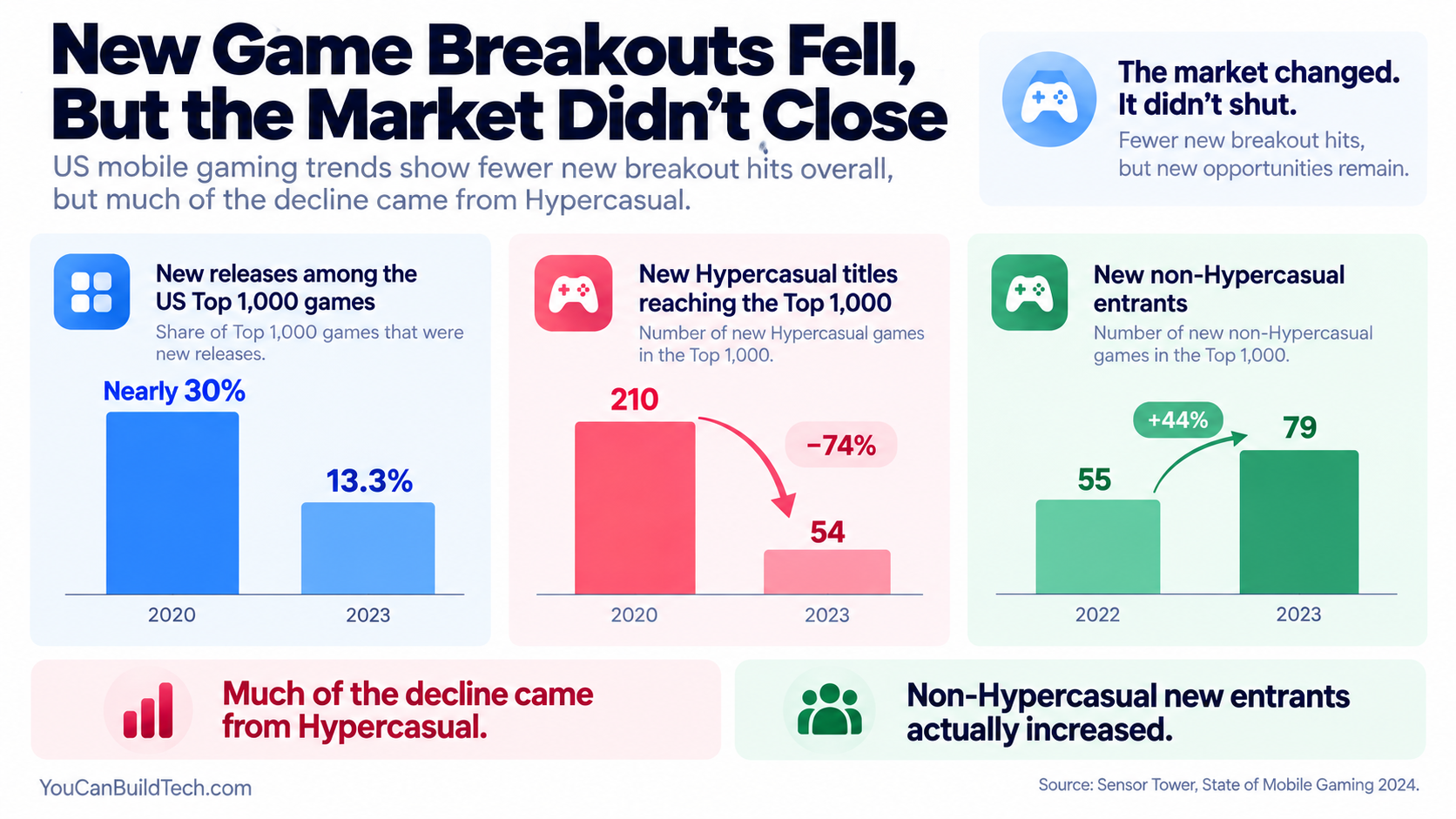
The better conclusion is not that the market is closing. The routes to success are changing.
Source: Sensor Tower, State of Mobile Gaming 2024.
AI Coding Changes the Market Again
This may be the most important current shift.
Unity reports that median development time for projects in its ecosystem fell 77% between January 2022 and December 2025, from 91 hours to 21. It also found developers increasingly favoring smaller projects and rapid prototyping.
RevenueCat and Appfigures separately found new subscription-app launches increasing from around 2,000 per month in January 2022 to more than 14,700 per month in January 2026.
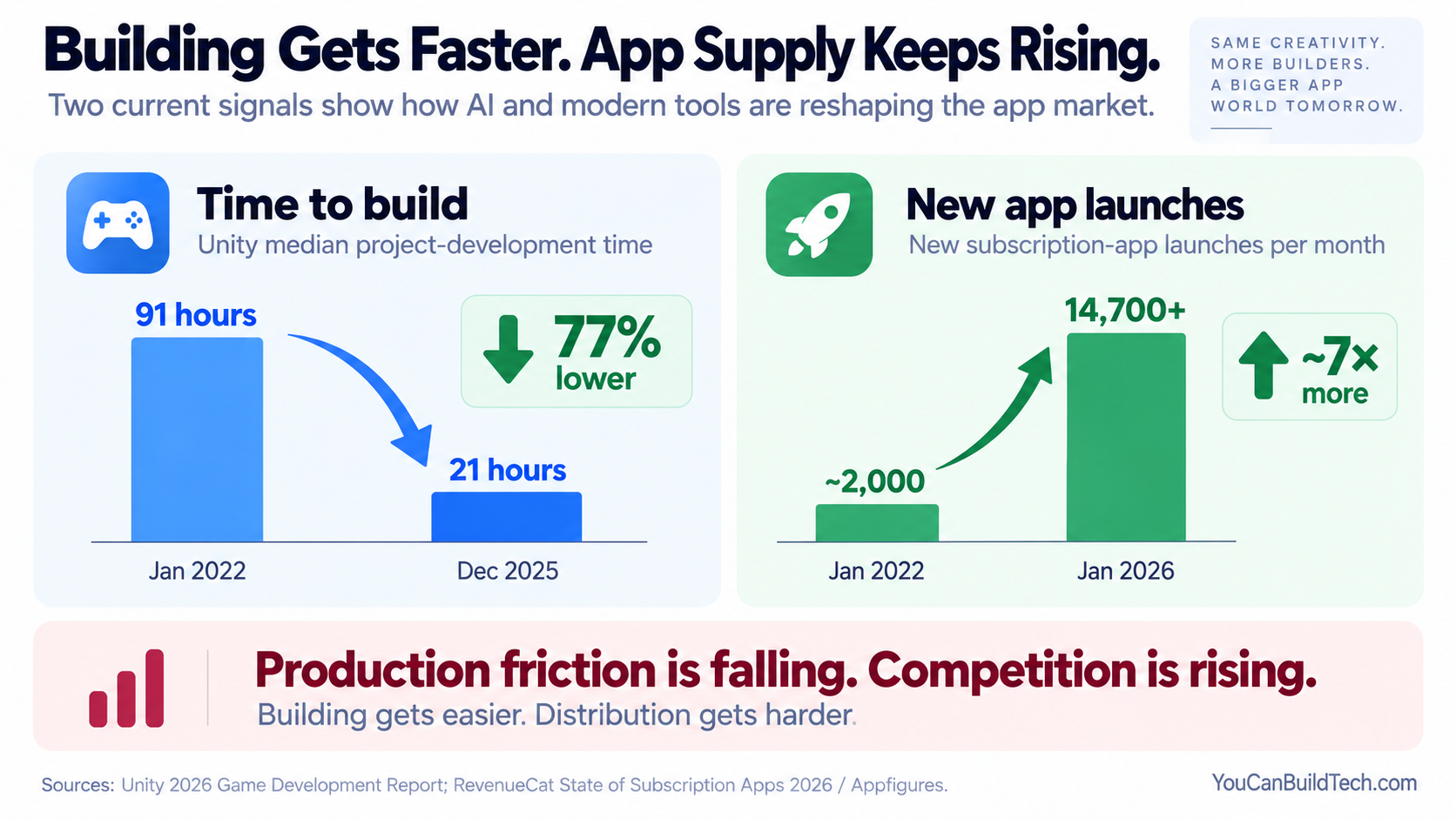
These datasets do not represent every mobile app, and neither should be treated as an AdMob-specific statistic. But together they show an unmistakable structural change: it has become much easier to produce software.
For an independent developer, that is enormously empowering. It is also enormously empowering for everyone competing with them. Increasingly, the harder questions are not simply whether the app can be built, but whether it should exist, who needs it, how those people will discover it and why they will keep using it.
Sources: Unity 2026 Game Development Report; RevenueCat, State of Subscription Apps 2026.
What Does the Current Landscape Suggest Comes Next?
Predicting which genres will dominate in 2028 would be guesswork. Current evidence is more useful for identifying what is becoming cheap and what is becoming valuable.
Coding and prototyping are becoming cheaper. AI functionality is becoming common. Competent software supply is increasing. At the same time, mobile developers currently cite competition, rising user-acquisition costs and discoverability as some of their biggest challenges.
RevenueCat's data also shows how entrenched mature products can become. Apps launched before 2020 still account for 69% of subscription revenue in its 2026 dataset. Older apps accumulate reviews, rankings, users, brand searches, optimization history and word of mouth. Those things cannot be generated instantly by asking an AI to write more code.
This suggests that distribution, retention, audience ownership, trust, positioning and judgment are becoming relatively more valuable.
AI itself provides an example. RevenueCat found AI-powered subscription apps converting users better initially and generating more Year-1 revenue per payer, but retaining subscribers worse than non-AI apps. Having AI can attract attention, but it does not automatically create recurring value. As AI functionality becomes common, the stronger question becomes whether it makes a specific product useful enough for the user to return.
That is ultimately the same retention problem AdMob developers have always faced.
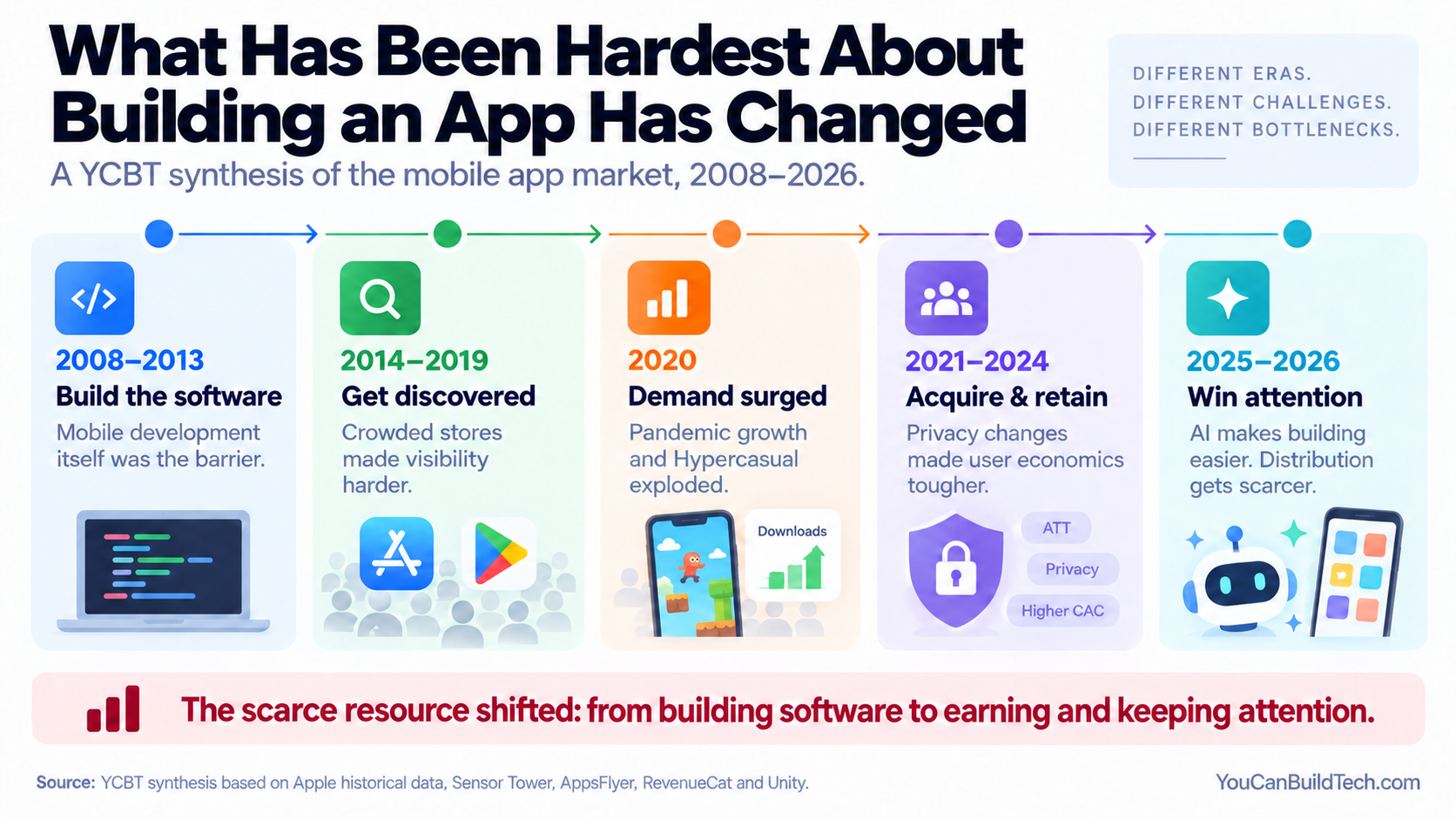
Sources underlying the synthesis: Apple historical App Store data for the 2008 launch, November 2009 and January 2013; Apple's 2025 App Store Transparency Report and transparency-report archive; Sensor Tower, State of Mobile 2026; AppsFlyer, State of App Monetization 2026; RevenueCat, State of Subscription Apps 2026; Unity 2026 Game Development Report.
Simple Apps Are Not Dead
The increasing sophistication of development tools does not mean every successful app needs to become enormous. Simple utilities and simple games can still work.
The distinction is between simple and generic.
Apple's review guidelines explicitly push against apps that are indistinguishable from products already widely available, including mature categories where a new app needs to offer something meaningfully different or improved. Google Play similarly prohibits repetitive or low-quality apps.
AI therefore creates an unusual pressure. It makes it easier to produce many similar apps, while stores and users have less reason to care about another indistinguishable one.
SIMPLE IS NOT THE SAME AS GENERIC
Lower technical complexity does not make an app obsolete. A simple product can still succeed if it is useful, engaging or distinct. The growing problem is indistinguishable software with no clear reason to exist.
The stronger opportunity may be to use cheaper development to make a simple product more specific, polished or useful rather than to produce more copies.
Sources: Apple App Review Guidelines, including sections 4.1 and 4.3; Google Play policies covering spam and repetitive content and functionality, content and user experience; Sensor Tower, State of Mobile Gaming 2024.
AI May Also Make Smaller Niches More Attractive
There is another side to cheaper development.
Suppose a very specific app could realistically produce only $500 a month. If building it requires a conventional development budget of $100,000, the market is too small to justify.
If one developer using AI and mature infrastructure can build and maintain it inexpensively, that same market becomes more interesting.
This means AI may produce two apparently contradictory outcomes at once: broad, obvious categories become more crowded while very small niches become more viable.
Large publishers generally need large markets. A solo developer does not. There may therefore be fewer obvious empty mass-market categories while simultaneously being more economically reasonable to build software for narrow groups that established companies would never pursue.
This is a forward-looking inference from falling production costs rather than a directly measured AdMob statistic, but it is one of the more interesting implications of the current market.
Solo Developers, Small Teams and Publishers Are Not Playing the Same Game
AI affects different kinds of developers differently.
A solo developer has never had this much production capability. One person can use AI across coding, debugging, research, copy, design and localization. Projects that once required several specialists are becoming possible for individuals, but the solo developer's weakness is usually distribution and bandwidth.
A small team can combine similar production leverage with specialization. One person can concentrate on the product, another on design or content, and another on marketing, community or analytics. This may become a particularly strong structure because it keeps costs relatively low while solving some of the limitations of working alone.
A publisher operates with a different set of advantages. AI reduces the importance of having a much larger engineering team, but it does little to remove an established publisher's audience, capital, marketing data, cross-promotion inventory, brand recognition or ability to run many experiments at once.
AI narrows the production gap much faster than it narrows the distribution gap.
Sources: Unity 2026 Game Development Report; RevenueCat 2026 distribution analysis; AppsFlyer app-marketing data.
So Is AdMob Worth It in 2026?
AdMob itself is not disappearing.
AppsFlyer's 2026 monetization research analyzed $7.2 billion in in-app advertising revenue and found advertising revenue growing 14% year over year.
What has changed is the sophistication of the surrounding business. Strong ad-supported products acquire users, give those users a reason to remain or return, create sensible opportunities for ads, attract audiences advertisers value, and avoid spending more on users than those users are worth.
Increasingly, ads may also coexist with other revenue. Remove-ads purchases, premium features, subscriptions or additional content can allow high-intent users to contribute more than advertising alone. AppsFlyer's data shows advertising continuing to grow while subscriptions and IAP are also expanding, and hybrid monetization is becoming more common across several categories.
That does not mean every app should contain five monetization systems. It means AdMob can be part of the business rather than the entire definition of the business.
Source: AppsFlyer, State of App Monetization 2026.
A Practical Way to Estimate Your Own AdMob Potential
If you are trying to judge whether an app has meaningful advertising potential, these questions matter more than a generic online revenue calculator.
1. How many people actually use it?
Downloads are historical. DAU and MAU tell you whether people are still there.
2. How often and how long do they use it?
Ten thousand people opening once is very different from ten thousand people returning every day.
3. What ad formats genuinely fit the app?
Rewarded ads and interstitials can be worth much more than banners, but only when they fit the experience.
4. Where are the users?
Country and platform can move advertising value by several multiples.
5. How many requests become real impressions?
Traffic does not automatically equal filled advertising inventory.
6. What is the actual eCPM?
Not an average from somebody else's blog. Your eCPM, for your users, formats and current market.
7. What did those users cost?
Organic users may have little direct acquisition cost. Paid users need to earn more over their lifetime than they cost to acquire.
8. Do they come back?
Retention can turn one user into months of future sessions and impressions.
If you know those eight things, you understand far more about your AdMob potential than somebody who knows only their download count.
What Our Research Cannot Tell You
The depth of the research does not remove the limits of the available evidence.
We cannot tell you the average AdMob developer earns a particular amount because no representative dataset we found provides that figure. We cannot tell you 10,000 DAU will produce a particular monthly income because real cases with similar user counts produce radically different revenue.
We also cannot give one universal figure for US eCPM, one fixed timeline to success or one revenue number for a particular app category. And we cannot tell you what percentage of developers will eventually live from AdMob.
Those are not missing numbers that should be filled with estimates. They are boundaries around what the available evidence can support.
This matters because an article can look more authoritative by putting exact numbers everywhere while actually becoming less reliable. Where the evidence stops, our numbers stop with it.
How We Researched This
We began with a large collection of first-person developer discussions, primarily from communities where developers publicly share AdMob dashboards, revenue milestones, traffic figures and monetization problems.
We gave more weight to reports that included specific revenue, DAU or MAU, impressions, eCPM, country mix, ad formats, time periods or screenshots. We separated first-person observed results from estimates and general opinions, and treated unsupported extreme claims as outliers rather than evidence of normal earnings.
Individual developer reports are useful because they show what real outcomes look like. They are weak at telling us how common those outcomes are.
We therefore compared the individual cases with official Google documentation and larger datasets from Appodeal, AppsFlyer, Sensor Tower, RevenueCat, Unity and other industry sources. Each type of evidence serves a different purpose. Google explains how AdMob works. Large datasets show broad market patterns. Developer reports reveal what actually happened to specific apps.
Taken together, they provide a much more useful picture than any one source could on its own.
Main Sources Used in This Study
Google AdMob
Definitions, reporting metrics, ad formats, eCPM, serving limits and invalid traffic.
Appodeal
Country, platform and ad-format eCPM comparisons across a large mobile-advertising dataset.
AppsFlyer
In-app advertising revenue, monetization timing, paid acquisition and broader monetization trends.
Sensor Tower
App-market history, changing genres, emerging categories and the balance between new releases and established apps.
RevenueCat
App-launch growth, incumbent revenue concentration, AI-app behavior and current distribution trends.
Unity
Development speed, AI-assisted production, project scope and team behavior.
Reddit developer reports
First-person earnings, user counts, traffic, app portfolios, acquisition methods, failures and success stories.
The Reddit reports are not audited financial statements and are not treated as representative of all developers. They are used as case studies alongside larger datasets.
The Bottom Line
AdMob can produce pocket change, meaningful side income, thousands of dollars per month or enough income to support a developer full-time.
But AdMob does not pay developers simply because an app has downloads. It pays when real users create real advertising opportunities, those ads are successfully served, and advertisers value the audience enough to pay for them.
The successful cases we found were not united by one magic app category, one user count or one monetization trick. They combined some mixture of demand, distribution, retention, valuable users and sensible advertising.
AI is now making the production side of that equation easier. That does not remove the opportunity. It changes where the difficult part sits.
Building an app is becoming cheaper. Building an audience, keeping its attention and turning that attention into a durable business are becoming more valuable.