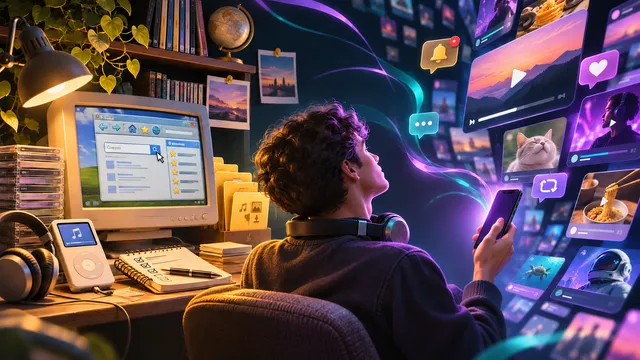
There's something exhausting about modern online life. The endless feeds, the notifications, the recommendations, and the feeling that you're never quite offline. You pick up your phone to do one thing, and twenty minutes later you're watching something you never intended to watch.
Doomscrolling has become such a familiar experience that we're increasingly questioning our relationship with technology. And some people are going further, buying old MP3 players, experimenting with basic mobile phones, and rediscovering hobbies that don't involve a screen.
I understand the appeal. But I think we're getting an important part of this conversation wrong.
The internet isn't the problem. And being online isn't necessarily the problem either.
In fact, I think much of the criticism is exaggerated. Technology has made our lives better in countless ways, and many people genuinely enjoy their online lives. Young people, in particular, are frequently portrayed as victims of their own technology, even though many use it to maintain friendships, explore interests, and express themselves.
A 2025 Pew Research Center survey illustrates this contradiction. Among American teenagers, 74% said social media helped them feel more connected to their friends, while 63% valued it as a place to express their creativity. Yet 45% also felt they spent too much time on social media.
That's a much more interesting picture than simply declaring that the internet is destroying a generation.
The question, to me, is not whether we should stop using technology. It's whether we can return to using it more deliberately.
Why are young people nostalgic for technology they never experienced?
There's a fascinating enthusiasm for the technology and culture of the late 1990s and 2000s, including among people who weren't even born then.
Old Windows desktops, Windows XP, retro gaming consoles, CRT televisions, early computer games, advertisements, shopping malls, and footage of everyday life from those years attract enthusiastic audiences on YouTube and TikTok.
There's something almost charming about watching a young person get excited about booting Doom on a 486 computer.
The interest extends well beyond computers. Some people are experimenting with dumbphones, reading more books, knitting, painting, and finding pleasure in simpler routines. They're not necessarily rejecting technology. They're exploring a different relationship with it.
This isn't entirely anecdotal. A 2026 American Psychological Association article examines why Generation Z is drawn to periods it never experienced, including older technology. Meanwhile, Axios reported a renewed interest in iPods, particularly among young people looking for a break from smartphone distractions.
I was born in 1984, so I'm fortunate enough to have experienced much of that technological transition firsthand.
And when I look back, the thing I miss most isn't Windows XP, an old monitor, or even my beloved MP3 collections.
It's the way we interacted with technology.
We used to seek it out
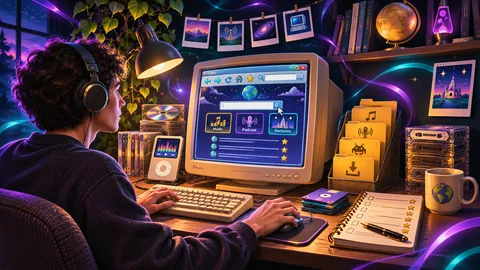
Back then, we had to seek it out. Now it feels like it's seeking us out.
I think that difference explains a remarkable amount about our modern relationship with the internet.
Consider how we discovered music in the early 2000s.
You might hear about a band from a friend, read about an album, or become curious about an artist. You'd remember that information, sometimes for days, and eventually sit down at your computer to find the music.
Maybe you'd open LimeWire and start searching. Finding exactly what you wanted wasn't guaranteed. You had to sort through files, check audio quality, look at download speeds, and figure out whether the song was correctly named or even belonged to the album you were looking for.
Finding an entire album could become a project in itself.
It wasn't always convenient, and the file-sharing systems of the time certainly had their problems. But the point is that you had already decided what you wanted before you went looking for it.
You were actively exploring your own interests.
And those interests continued developing even when you weren't online. You'd remember a band you wanted to investigate, a website you wanted to revisit, or an album somebody had recommended.
The same experience extended to podcasts as they became popular during the mid-2000s.
You might search Google for metal podcasts, discover a small website dedicated to interviews with musicians, and spend an evening exploring its archives.
Perhaps you'd find three interviews with an artist you were particularly interested in. You'd download them, transfer the files to your music player or phone, and listen whenever you wanted.
You might bookmark the website or simply remember its name. A week or two later, you'd come back to see whether anything new had appeared.
This was a normal part of early podcast listening. In fact, Pew Research Center described precisely this download-and-transfer process in 2005.
There were more steps involved, but there was also something deeply satisfying about it.
You were searching, collecting, organizing, remembering, and gradually building a collection around your interests.
And every single part of that experience took place on the internet.
The internet is not social media
This is the distinction I wish more people would make.
When someone describes the internet as inherently addictive or mentally exhausting, I often wonder what they actually mean.
Are they talking about researching an interest? Downloading a podcast? Reading an interview? Discovering a small website about an obscure musical genre?
Or are they talking about spending two hours scrolling through an algorithmically generated feed?
Those are very different activities.
The internet is a technology that supports an enormous variety of activities. Social media is one category of services that operates on it. Treating the two as interchangeable makes about as much sense as treating every computer program as a video game.
The internet I remember was full of discovery, exploration, and personal interests. Much of it still exists today.
What has changed dramatically is how some of our largest platforms present information and entertainment.
Now the content comes looking for us
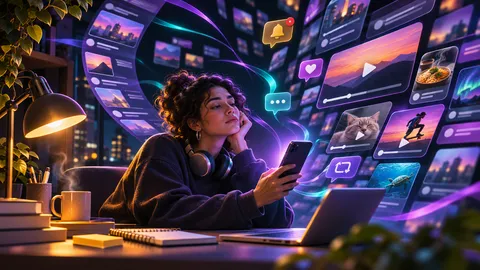
Open YouTube, TikTok, Instagram, or almost any major entertainment platform, and you're immediately presented with things to consume.
Some recommendations are excellent. I've discovered plenty of worthwhile content through algorithms.
But there's a difference between receiving a useful recommendation and being placed in a continuous stream of recommendations that never really ends.
You watch a video, and another appears. Then another. Maybe it's a clip from a longer interview, followed by someone reacting to that clip, followed by somebody reacting to the reaction.
You weren't particularly interested in any of it. But you keep watching because every few seconds something is mildly entertaining.
And that, to me, is one of the most frustrating aspects of modern online entertainment. You can consume a considerable amount of content without finding much that you genuinely wanted to see.
The scrolling itself becomes the activity.
This isn't merely an imagined difference. A 2025 study published in Social Media + Society examined how TikTok's interface encourages passive consumption through its recommendation system, limiting how directly users can control what appears in their feeds.
There are also legitimate concerns about stress and well-being. A 2025 randomized controlled trial found improvements in stress, sleep quality, and psychological well-being when participants substantially reduced their smartphone screen time for three weeks. That doesn't mean every kind of screen use has the same effect, but it does suggest that changing our habits can make a measurable difference.
And people are increasingly making those changes. In a 2025 American Psychiatric Association poll, half of the American adults surveyed said they had actively limited their social media use that year.
I also find the constant expansion of entertainment platforms rather strange. Even Netflix, which I might open simply to watch a film, now wants to introduce me to games.
Apparently, watching a movie isn't enough anymore.
What I miss is the simpler relationship: I decide what I want to do, open the appropriate application, and do it.
Going back doesn't mean giving anything up
There's a tendency to treat older approaches to technology as inferior simply because something more convenient has replaced them.
I disagree.
Consider using an MP3 player instead of relying entirely on streaming services.
You might have a smaller selection of songs immediately available, but that isn't necessarily a disadvantage. You're more likely to have a collection filled with music you already enjoy.
You might also start listening to albums again.
Albums were an enormous part of music culture for good reason. They offered a different experience from jumping between individual hits. You could discover songs you would never have selected individually and gradually develop an appreciation for an artist's broader work.
I'd call that an upgrade in how you experience music, not a downgrade.
Podcasts offer an equally interesting opportunity.
With a good podcast player, you can subscribe directly to creators you like, browse their archives, download episodes, and maintain your own growing collection.
If much of what you watch on YouTube consists of interviews, discussions, and other content that's also distributed as podcasts, you may discover that you hardly need YouTube at all.
And unlike an algorithmic recommendation feed, you don't have to trade variety for control.
You can keep discovering new creators, subscribing to new shows, and expanding your collection. In fact, that process of actively seeking out interesting material is precisely what makes it enjoyable.
Then there's RSS, which might be my favorite example of how older internet technology can still improve modern life.
An RSS reader allows you to subscribe directly to the websites and publications you want to follow. Once you've created a good collection, you can open the application and find updates from sources you've personally chosen.
No need to visit twenty websites individually. No need to depend on a recommendation feed that might show you one interesting article surrounded by five things you couldn't care less about.
RSS combines the deliberate discovery of the older internet with modern convenience. You put in some effort choosing your sources, and the software makes following them easier afterward.
That's not returning to the Stone Age. That's using technology well.
What we're building at YouCanBuildTech
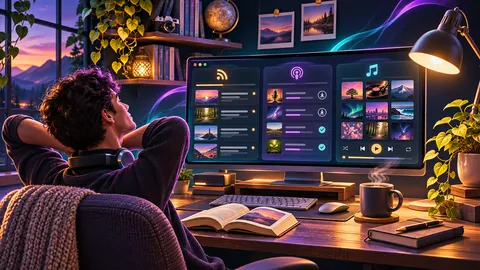
This philosophy is one reason we're developing our own software at YouCanBuildTech.
We're working on an MP3 player, a podcast player, and an RSS reader, built around the kinds of experiences we've been discussing.
These are passion projects. We genuinely enjoy this approach to technology, and we want to create applications that combine the best parts of earlier computing with the capabilities, design, and convenience available today.
We're not trying to recreate every inconvenience of 2003. There's no reason downloading and organizing music should be unnecessarily complicated, or that an RSS reader should look like a spreadsheet from twenty years ago.
The goal is to preserve what made those experiences worthwhile while making the applications as good as we can.
And because YouCanBuildTech is also about teaching people to create software, we want to show readers how to make applications like these themselves. We've already written about how we built our MP3 player with AI, and we want to continue sharing that development process.
That's where it all comes full circle.
We can use the newest programming tools, including AI, to build applications that bring back some of the freedom and independence we enjoyed with older technology.
We don't need to abandon the modern internet. We just need to remember that we're allowed to choose how we use it.
And personally, I'd much rather spend my time seeking out something I genuinely want than endlessly scrolling through things an anonymous algorithm thinks I might consume.